
Why Jaw Clenching Causes Surprising Neck Pain in Toronto
- Myotherapy Toronto, Registered Massage Therapy
Categories: Jaw Clenching , Neck Pain Relief , Posture Correction , Toronto Massage Therapy
You sit at your desk in downtown Toronto, reviewing quarterly reports while your shoulders creep slowly upward toward your ears. By mid-afternoon, a sharp ache wraps around the base of your skull, stiffening your upper spine and making it difficult to turn your head. You might assume your ergonomic office chair is inadequate, or perhaps your screen height needs adjustment. While desk posture certainly plays a part, the true source of your discomfort often rests higher up along your jawline. Unconscious clenching during stressful commutes on the Gardiner Expressway or demanding corporate meetings triggers intense muscular tension throughout your entire neck and upper spine.
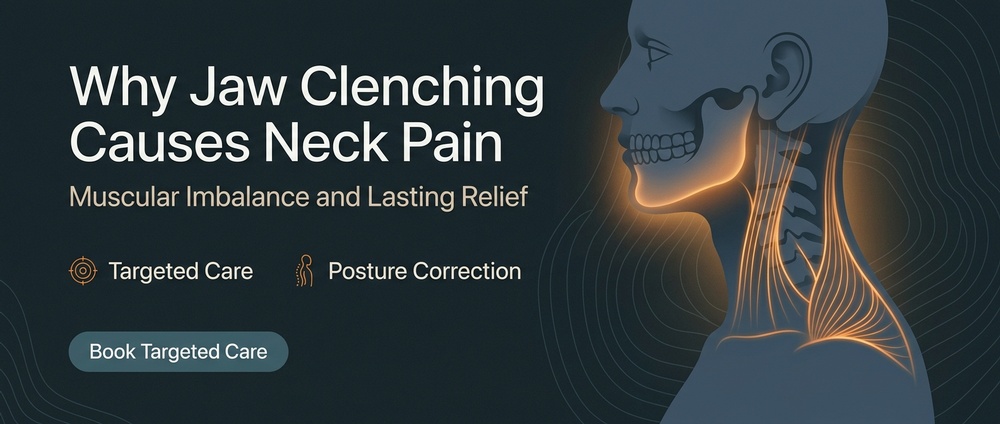
When you compress your teeth together under focus or pressure, your temporomandibular joint absorbs tremendous force. This joint does not operate in isolation. It shares complex fascial webs, reciprocal muscle patterns, and neural pathways with your upper cervical vertebrae. If you continuously clench during the day or grind your teeth at night, that mechanical stress travels straight down into the muscles supporting your head. Working directly with a licensed Massage therapist allows you to identify these hidden muscular relationships, systematically addressing the root dysfunctions rather than simply masking the recurring ache.
Living with chronic upper body stiffness reduces your daily productivity, disrupts restorative sleep, and drains your personal stamina. When you overlook the direct link between dental clenching and spinal stability, standard stretching routines fail to provide lasting comfort. Restoring proper mobility requires an intentional strategy that targets the deep muscles of the jaw, skull, and cervical region simultaneously. Examining how these systems interact will help you break the cycle of recurring tension and reclaim fluid movement.
The Biomechanical Connection Between the Jaw and the Cervical Spine
Your jaw mechanics directly dictate how your neck stabilizes your skull throughout the day. Every time your teeth make contact, your masseter, temporalis, and pterygoid muscles contract. These powerful closing muscles generate substantial upward pressure. To keep your head balanced during this contraction, your suboccipital and deep cervical muscles must fire at the exact same moment. This involuntary co-contraction provides a solid foundation for the jaw to bite down against, meaning your neck never receives a chance to rest while your jaw remains clenched.
Over hours of sustained concentration, this compensatory holding pattern exhausts your neck stabilizers. The trigeminal nerve, which governs jaw sensation and muscle activation, shares spinal cord pathways with the upper cervical nerves that govern your upper neck. This neurological overlap, known as the trigeminocervical nucleus, causes the brain to confuse jaw discomfort with neck pain. Consequently, severe tension within the temporalis or masseter radiates downward, manifesting as persistent tightness along the top of your spine.
As these muscles shorten, they pull your skull into a slight backward tilt. To compensate and keep your eyes level with your monitors, your lower cervical spine bends forward, locking your head in an unnatural alignment. This constant battle between anterior jaw strain and posterior cervical resistance forms a persistent mechanical trap. Without intervention, these tissues adapt to this shortened state, making normal upright posture feel exhausting.
Addressing this feedback loop requires targeted cervical spine muscle release. Releasing the primary masticatory muscles allows the opposing cervical stabilizers to lengthen naturally. Restoring equilibrium across these opposing muscle groups relieves constant mechanical load, allowing your spinal joints to move through their full, natural range without triggering protective muscle spasms.
How Clenching Warps Postural Alignment
When chronic clenching sets in, the resting resting position of your head shifts forward. Each inch your head moves in front of your shoulders dramatically multiplies the effective weight your spinal extensors must support. Your trapezius, levator scapulae, and rhomboids are forced to work continuously like tether cables, fighting against gravity to prevent your head from slumping forward onto your chest.
This postural shift initiates a cascade of structural compensations throughout your entire upper torso. As the head migrates forward, your shoulder blades flare outward and rotate downward, shortening the pectoralis minor muscles across your chest. This rounding of the upper back creates chronic strain across the thoracic spine, leading to the familiar burning sensations experienced between the shoulder blades after long hours at a workstation. The issue is rarely isolated back weakness; it is frequently an adaptive response anchored by a tight, overworked jaw.
Attempting to fix this posture by simply forcing your shoulders back often creates further discomfort. When your jaw muscles remain hypertonic, pulling your shoulders back only introduces conflicting tensions into your mid-spine. A structured posture correction massage breaks this compensatory pattern by addressing both the shortened anterior tissues and the exhausted posterior muscles. Balancing tension across the front and back of your torso allows your head to settle back over your shoulders without forceful muscular effort.
Restoring natural alignment also relieves excessive pressure on your intervertebral discs. When your cervical spine maintains its gentle inward curve, mechanical loads distribute evenly across the vertebrae. By correcting the jaw-driven forward head position, you prevent accelerated wear on these delicate spinal structures and allow your postural muscles to work efficiently.
Identifying Signs of Clenching-Related Neck Pain
Many individuals clench their jaws without realizing it, as the habit frequently occurs during deep focus or sleep. You might wake up with an unexplained stiffness in your upper neck and conclude you slept at an awkward angle. However, specific indicators distinguish clenching-induced neck pain from general muscular fatigue:
- Waking up with tightness or tenderness along the sides of your head, temples, or jawline that extends into your upper shoulders.
- Frequent dull headaches that originate at the base of your skull and wrap around your ears toward your forehead.
- A sensation of fullness or clicking in your ears accompanied by localized neck restriction when turning your head to check blind spots while driving.
- Noticing that your upper and lower teeth remain pressed tightly together while you read emails, type, or focus on demanding tasks.
- Chronic tender knots in your upper trapezius muscles that return shortly after conventional shoulder stretches.
Recognizing these combined symptoms allows you to address the primary cause rather than chasing peripheral discomfort. When jaw tension goes unaddressed, standard treatments focused solely on the shoulders often yield only temporary relief. Connecting the dots between your daytime focus habits and nighttime grinding patterns empowers you to seek therapies that resolve the entire structural chain.
Targeted Massage Approaches for Cervical and TMJ Tension
Resolving persistent neck and jaw discomfort requires a multi-layered therapeutic method. Standard relaxation bodywork rarely penetrates deeply enough to release chronically bound jaw and cervical tissues. A focused clinical approach targets the specific structures responsible for maintaining the holding pattern, working methodically through the superficial fascia down into the deep stabilizing muscles.
Effective care often begins with external work along the masseter, temporalis, and suprahyoid muscles to reduce elevated jaw tone. Therapists then evaluate and release the suboccipital muscles, which sit directly beneath the skull base. These tiny muscles contain an exceptionally high concentration of sensory receptors and lock up tight in response to jaw clenching. Systematically working these deep cervical anchors relieves pressure on the greater occipital nerve, instantly easing tension headaches and restoring smooth head rotation.
Integrating gentle movement during soft tissue work produces significantly longer-lasting results. By carefully moving your neck and limbs through guided ranges while applying precise pressure to trigger points, a therapist encourages muscle fibers to slide freely against each other. This movement-based release breaks stubborn fascial adhesions that static pressure alone cannot resolve. The therapist also balances the antagonist muscles across your chest and upper back, ensuring that no single muscle group remains overstretched or overloaded.
A specialized neck and back pain massage plan provides the firm, intentional pressure needed to reset these dysfunctions. By customizing the depth and rhythm of the treatment to match your comfort level, clinical massage therapy releases chronic trigger points while keeping your nervous system calm and receptive to structural change.
Daily Strategies to Reduce Jaw Tension and Protect Your Spine
In-clinic treatment provides the necessary foundation for tissue recovery, but daily self-care maintains structural balance between appointments. Implementing small, conscious habits throughout your workday protects your cervical spine from the damaging effects of unconscious clenching:
- Practice the resting jaw posture: keep your lips closed, teeth slightly apart, and the tip of your tongue resting gently on the roof of your mouth just behind your front teeth.
- Set gentle visual cues or timers on your workstation monitor to remind yourself to drop your shoulders, unclench your teeth, and take a slow, diaphragmatic breath.
- Apply moist heat to the sides of your jaw and the back of your neck for ten minutes in the evening to soften hypertonic tissues before going to sleep.
- Avoid resting your chin in your hands or cradling a telephone between your shoulder and ear during long calls, which places extreme torsional stress on both the TMJ and neck.
- Perform gentle chin tucks throughout the day to activate your deep cervical flexors and counteract the forward head posture caused by screen work.
Adopting these small behavioral shifts disrupts the unconscious neuromuscular loops that drive daytime clenching. When you pair conscious posture awareness with regular therapeutic releases, you prevent tension from accumulating to the point of pain. Your body gradually unlearns the protective clenching reflex, preserving your energy and keeping your movements fluid.
Long-term physical comfort depends on understanding that your body functions as an interconnected system. Chronic neck pain is rarely just a neck problem, especially for busy professionals navigating high-demand environments. By recognizing the direct connection between jaw stress and spinal alignment, you can pursue targeted therapeutic solutions that provide genuine, sustainable relief.
If you are ready to identify the source of your neck stiffness and restore easy, pain-free mobility, personalized clinical support is available. You can arrange a comprehensive physical assessment and discuss your treatment goals directly by emailing myotherapyto@gmail.com to take the first step toward lasting comfort.